What's new on spacesheep. We ship improvements to the /sheep skill, the in-viewer assistant, and publishing continuously.
September 13, 2026 · New
Dark mode
The dashboard, settings, messages, profiles and the frame around every space now follow your system's light or dark setting, and the account menu has a picker if you'd rather pin one. A published page keeps the colours its author gave it — a lit sheet in a dark room rather than an inverted one, so charts and photos look the way they were built.
September 13, 2026 · New
Send a whole call, not just a voice note
Voice and audio recordings up to 90 minutes now go through on Telegram and in the web chat: a half-hour investor conversation comes back as a complete transcript your agent reads in full, so “make a space from this” works on the whole call. Video stays at ten minutes. A recording sent as a file, or a typed-out transcript attached as a text file, is read too instead of being dropped — and when something is too long or too big, the reply names the one limit you hit.
September 13, 2026 · New
Model roles: fast for chat, premium for builds
Settings → AI assistant has an optional “Model roles” section. Set a fast model and your agent uses it for quick replies, status answers and small chat turns. Set a premium model and the agent decides, ask by ask, whether a build deserves it — a game, a deck or a dashboard goes premium, a note or a one-line tweak stays on your main model — and the run's first line says which one ran and why. Leave both blank and nothing changes.
September 13, 2026 · New
Browse and download everything your agent remembers
From Your Memory, open the browser to walk through every fact by kind, every day of conversations in your own timezone and every digest, with search across all of it and links between related facts. Download hands the same archive over as a zip of markdown files.
September 13, 2026 · New
Send photos from your phone automatically
A phone automation (Shortcuts, Tasker, MacroDroid) can push a picture straight to your agent with your API key the moment it's taken. It lands in your photos like one sent on Telegram, caption and location included, ready for the next space.
September 13, 2026 · Fix
Comments work for everyone who can read a space
On a public or link-shared space, readers who weren't the owner could open the comments rail and get nothing — the button didn't respond and every post was refused. Anyone who can read the space can now read the thread, post, react and delete their own comments. Resolving someone else's thread and @mention suggestions still belong to the people on the space's list.
September 13, 2026 · Improved
The star is now a bookmark
What the star did was keep a private shortcut to a page you want back — which is a bookmark, and next to a heart it read like a rating. It's drawn and named as a bookmark now, on cards, in the viewer and in the dashboard filter. Anything you had starred is already bookmarked.
September 13, 2026 · Improved
Public pages load faster
A public space is now served from the network edge closest to the reader, so a page that has been opened once opens in a fraction of the time after that, and a link that gets shared widely stays quick.
September 13, 2026 · Fix
A Telegram message delivered twice runs once
Telegram re-sends a message when it isn't acknowledged quickly, and each copy used to become its own run — one voice note turned into three transcriptions and two reminders for the same birthday. Repeats are now recognised and dropped.
September 13, 2026 · Fix
Continue picks up a paused draft cleanly
Pressing Continue on a paused agent draft could snap the panel back to the paused card over a build that had just started, and a second press said it could no longer be resumed. The new attempt now starts clean and the panel follows it.
September 13, 2026 · Improved
AI assistants that open a space link are told how to get in
When Claude, ChatGPT or another assistant fetches a link to a space it can't read, the page now tells it to connect the spacesheep MCP server and where the docs are — including how to set up Telegram or Slack — instead of a bare “sign in”. People see nothing different, and nothing about the space itself is revealed.
September 13, 2026 · Improved
Up to seven API keys
You can keep seven personal API keys instead of five, and a CLI login that can't mint one now tells the terminal why instead of leaving it waiting.
September 11, 2026 · New
Watch your agent work
“Your Agent” in the account menu shows every run as it happens: each step, every tool call with what it did and how long it took, and the agent's own decisions — a retry, a fallback model — where they happened, with a clock ticking on the live ones. Every run has a link you can copy and share; only you can open it.
September 11, 2026 · Improved
Several photos at once are one ask
Send an album on Telegram and it's read as one message — every photo on the same turn, the caption alongside — instead of one silent run per picture. Up to three of your asks now run side by side rather than queueing behind each other, and reading a photo takes a few seconds again whichever model builds your pages.
September 11, 2026 · Improved
Instagram slides are drawn edge to edge
A chart or slide your agent drew for Instagram used to be pasted onto a white 4:5 canvas with bands top and bottom. Now the drawing is the slide: the agent draws it at the right shape, looks at it before posting and redraws one that came out wrong. And a post that reached your feed is reported as posted, even when Instagram answers the publish with a rate-limit error.
September 10, 2026 · Improved
A page about places gets a photo for each one
Ask for a road-trip route, a list of cafés or a menu, and your agent now puts a photograph on every stop or dish — from your own photos, imported off the web, or drawn — rather than one picture on a page of nine. A page that comes back with no pictures is held back once and asked whether it really needs none; a memo or a dashboard goes through as-is.
September 10, 2026 · Fix
A build that couldn't publish says so
When research came back empty or the model stalled mid-build, your agent could send a tidy outline of the page in chat and call it done, with nothing saved. It now makes one more attempt to publish and, failing that, tells you what failed and that nothing was saved. A web search that isn't working hands its step to another one you have connected instead of sinking the whole build.
September 10, 2026 · New
Move or cancel a meeting from chat
“Make a meeting with Shoya tomorrow at 1” now goes straight to your calendar instead of being planned as a document. Your agent can also reschedule and cancel Google Calendar events, and a change it couldn't make is reported as exactly that rather than as a success.
September 10, 2026 · Improved
The composer waits while a draft is being built
While your agent drafts a document the goal box is locked — edits there had nowhere to go — and when the document lands, the way to it is a green button rather than a text link.
September 9, 2026 · New
Your Memory: a page that shows what your agent knows
Every person with any memory gets a private space called Your Memory, refreshed nightly: facts by kind, conversations by day and by channel with your streaks, the latest digest, your documents with their readers and comments, your recent agent runs, tasks and linked channels. Open it from the account menu; delete it and it stays gone until you ask for it back.
September 9, 2026 · New
Like a space
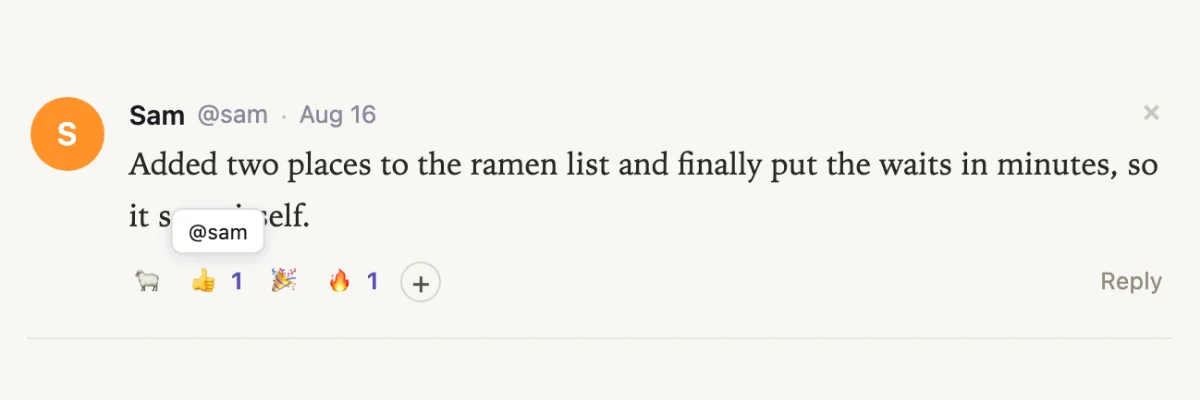
A heart sits beside the bookmark on every space card and in the viewer header. A like is public: everyone who can see the space sees the count, and the owner hears who liked it in the bell. The bookmark stays private. Tap the heart and one floats away.
September 9, 2026 · New
Turn off reactions on a page
Some pages are meant to be read or used, not reacted to — a tracker doesn't need 👍 under every progress bar. In the comments sidebar, an owner can switch off new reactions for the whole space. Reactions already left stay as plain counts, and commenting is untouched.
September 9, 2026 · Improved
Hide resolved comment threads
The comments sidebar has a “just for you” switch that hides resolved threads on a space where the review is done. A link to a resolved comment still opens it, and the header count says “2/4” while some are hidden.
September 9, 2026 · Improved
Your agent acknowledges with 👀
On Telegram and Slack, the agent no longer posts “On it — building that now” and edits it as it goes. It marks your message with a 👀 reaction while it works and clears it when done, so the thread is just your words and its answers.
September 7, 2026 · New
A blank document asks what to build
Open a new, empty space and the Co-shepherd opens itself with “What would you like to create?”, three examples that fill the composer, and edit mode already on — so “build me a landing page” builds one rather than describing one. Close it once and it stays closed on that space.
September 6, 2026 · New
The Co-shepherd is a room
The Co-shepherd thread on a space is now one thread everyone with access sees, with a name and a face on each message, and a space takes one agent turn at a time: while someone's edit is running, the panel shows whose it is and what they asked, and the owner can stop it. If you can only read the page your question runs alongside. Two people can no longer overwrite each other's edits.
September 6, 2026 · New
Share a space read-only
The share dialog has a “let them make edits” checkbox, on by default. Untick it and everyone on the space's guest list becomes a reader: the Co-shepherd, version restore and the editing tools go read-only for them, and the “People with access” line says which it is.
September 6, 2026 · Improved
Version history says who made each edit
Each version in the history dropdown now shows the face of the person who made it — for an agent edit, the person who asked — with their name on hover. Versions from before this show no author rather than a guess.
September 6, 2026 · Improved
Drag the Co-shepherd tab out of the way on a phone
The tab sat at mid-height on the left edge, exactly where a page tends to put its own buttons. Press and drag it up or down and it stays where you dropped it, per device. The close buttons on the Co-shepherd panel and the comments rail are bigger too.
September 5, 2026 · New
See that your agent is working, wherever you asked
Ask for a document on Telegram and open the dashboard: three walking dots beside the logo say the agent is busy, on every signed-in page and in the viewer. Hover or tap them for what it's working on, where you asked and how long it has been going; a queue shows the oldest job and counts the rest. The Co-shepherd tab spins while a turn runs there.
September 5, 2026 · New
Put a picture from the web on the page
“Add the poster from IMDB” used to end in a refusal or a link that broke for some readers. Your agent can now list the pictures on a web page and import one into the space, where it's served like your own photos; every picture it pulls shows up in your thread with its source.
September 5, 2026 · Fix
The Co-shepherd no longer publishes pictures that aren't there
An edit could reference photos that were never imported and publish a page of broken image boxes while saying “Done”. The editor now refuses such an edit before it touches the page, and tells you if anything went missing between the edit and the version.
September 4, 2026 · New
Who read a space, and when
Open Analytics on a space you own — from the viewer header or the card's ⋯ menu — for lifetime views, unique readers, a 30-day chart and a list of signed-in readers by name with when they first and last opened it. Anonymous readers are counted, not named; your own visits stay off the list.
September 4, 2026 · New
Builds and edits keep going when you close the tab
A dashboard draft or a Co-shepherd edit used to die about thirty seconds after you navigated away. They now run in the background: every open tab follows the progress, a tab opened mid-run picks it up, the bell tells you when it lands, and Stop ends it immediately. A run interrupted by an update resumes from where it was instead of starting over.
September 4, 2026 · Improved
Comments you can follow
Replies nest under their parent, long threads fold to the last two, every thread has its own Reply box, and comments posted since your last visit wear a “new” pill with the count on the header button. Enter posts, Shift+Enter breaks a line, Escape closes the rail. A new comment now reaches the space owner and a reply reaches everyone in that thread — before, a comment without an @mention notified nobody.
September 4, 2026 · Improved
The agent says “done” only when it is
Your agent will no longer send a link it never made, call a deck ready when it only listed your photos, or post half a sentence because the model stopped mid-word. Every reply is checked against what the run actually did; a run that ran out of steps says what it got through and how to continue, and one whose publish failed says so instead of asking whether you'd like it deployed.
September 4, 2026 · Improved
Ask how it's going while it builds
Messages sent while your agent is busy are answered right away by a quick agent that reads the live record — how long the job has been working versus waiting its turn, and what it's doing now — instead of queueing behind the build. Say “actually, make it about X” and it stops the running build and starts the new one. If a run hasn't answered within eight seconds you hear something, and the typing indicator on Telegram stays on for the life of the job.
September 4, 2026 · Fix
Loading indicators no longer freeze with Reduce Motion
With Reduce Motion on (common on iPhone and iPad), the typing caret, loading skeletons and the loading sheep sat still, so a page that was loading looked hung. They now fade gently instead of moving, keeping the signal without the travel.
September 3, 2026 · New
Post to Instagram from a chat
Ask your agent to post pictures you have sent it — one photo, or a carousel of slides. It builds a private preview page with the slides and the caption on it and sends you the link; nothing reaches Instagram until you press Confirm there. It can lay a label and a number over a photo first, or build a collage cover, and it connects with a token from the Instagram app dashboard — no Facebook Page needed.
September 3, 2026 · New
Your agent can look at a photo again
Ask about a picture you have sent — the one from a minute ago, or one from months back — and the agent opens the file itself instead of working from a one-line description of it. So “which fish is that” now has an answer. Which model does the looking follows the one you picked in Settings, as long as that model can see pictures.
September 3, 2026 · New
Shorter answers, and a picture when a picture is faster
Chat replies lead with the answer instead of a wall of text. For comparisons, numbers, steps and timelines the agent now draws the answer and sends it as an image, and page screenshots come back phone-shaped so they open inside the message rather than arriving as a file to download.
September 3, 2026 · New
It remembers the right thing without being asked
Facts you have told your agent, and past conversations that match what you just said, are now pulled into every reply on their own rather than waiting to be asked for. Matching is by whole words with a relevance floor, so a note about your timezone does not surface every time you say “time”.
September 3, 2026 · New
Made with spacesheep, on the home page
The landing page now has a showcase of published spaces, each card framing the real live document rather than a screenshot of it. Promote to Featured on a public space's card is what puts one there, and a space that later goes private drops out on its own.
September 3, 2026 · New
Your memory and photos, from any assistant
Connect Spacesheep to ChatGPT, Claude or Grok and it can now use what it knows about you, not just deploy and read pages: remember and recall facts, look back over past conversations by date, and list or open your photos. Team agents are deliberately left out of this — a shared workspace is not one person's memory.
September 2, 2026 · Improved
Emails that look like the rest of the product
Invites, shares and password mails now use the app's own colours and the real pixel sheep in the masthead, at contrast that passes on both light and dark clients — and the card fits the phone it is read on.
September 2, 2026 · New
A Media tab on your profile
Every picture you have shared, in one grid by month, newest first: images in your posts, pictures inside spaces someone can already open, and — on your own profile only, marked private — the photos you sent your agent and the ones it drew. Click one for a lightbox you can walk with the arrow keys or a swipe.
September 2, 2026 · Improved
Hover a reaction to see who left it
Reactions now use one hover card across the product — the feed, the dashboard, and reactions left on a published page — naming the people behind each emoji. It waits a moment before appearing, so a pointer crossing a row of chips does not set off a flicker, and a keyboard gets the card too.
September 2, 2026 · Improved
Where a photo was taken stays yours
A phone photo carries the spot it was taken, to within a few metres. The original you send keeps it, so “where did I eat that” has an answer — and the copy that goes into a space is stripped of it. Always, private spaces included, because a space's audience can widen with one click and a picture would carry those coordinates forever after.
September 2, 2026 · New
Photos you send can go in a space
A picture in a Telegram DM is kept, not just described and thrown away. Ask the bot to put those files in a space — a slideshow of what you ate Tuesday uses the real photos. Agents building a page can also download royalty-free pictures (Openverse, Unsplash, Pexels) so a place or a product isn’t a wall of text.
September 2, 2026 · New
React to a paragraph right on the page
Hover or tap a heading, a chart, a block of text — a pill of emoji appears on the document itself. Sections keep a standing row of reactions at the bottom, so a phone can react without hovering. The owner is notified, and everyone looking at the space sees the chips update live.
September 2, 2026 · Improved
New accounts sign in with Google
Creating an account with an email and a password is closed. Continue with Google to join. If you already have a password, it still works — including reset from the sign-in page — and a Google account can add a password under Settings → Account so either one signs you in.
September 2, 2026 · New
Courtesy access — someone can lend you their AI keys
A person with connected tools can give you Courtesy access: a one-address link, or an admin grant. The assistant then runs on their keys until you add your own. A banner on the dashboard names who sponsored you and points at Settings.
September 2, 2026 · New
The assistant keeps a journal of every chat
Every exchange — on the dashboard, in the page assistant, and in Telegram DMs — is kept, not wiped after a night. Ask what you talked about last Tuesday, last month, or last year and it can pull that stretch back. Forgetting still deletes; everything else stays.
September 2, 2026 · New
See the words that started a space
Open the in-page assistant on a space you built and the first message is the brief that created it, with where and when it was typed. Only you see it. A space made from a file upload, or with no prompt, has nothing to show.
September 1, 2026 · New
Sign in with email and password
If you already have a password, it still works — sign in from the same card, or reset it from the sign-in page. Google accounts can add a password under Settings → Account so either one works. New accounts now sign in with Google.
September 1, 2026 · New
Charts and stat blocks, written in one line
An agent can now drop a short tag into a space — a stat, a row of key numbers, bars, a sparkline, a timeline or a line chart — and publishing turns it into a finished chart. Nothing loads in the reader's browser: the picture is drawn once, when the space is published, so the page stays as light as plain text. Publishing also warns about the things that make a page awkward on a phone, like fixed widths and walls of text.
September 1, 2026 · New
Ask for a design review of a published space
The new design_review tool opens your space at phone and desktop size and has your own AI model look at both pictures, then hands back specific problems with the smallest fix for each. It catches what a text check can't — cramped spacing, an unreadable chart, a heading that disappears — because it is looking at the page rather than the markup.
September 1, 2026 · New
Links can point at a spot inside a space
A link ending in #something now opens the space at that section instead of the top. It works both ways: a space with tabs can tell the address bar which tab you're on, so the link you copy brings someone back to the same place.
September 1, 2026 · New
Azure OpenAI and NVIDIA's Nemotron join the models you can connect
Azure customers can point the assistant at their own Azure OpenAI deployment — Settings asks for the endpoint alongside the key, and the model field takes your deployment name. Nemotron 3 Nano is available through NVIDIA's own endpoint. Both show up everywhere the other models do.
September 1, 2026 · Improved
Spacesheep on a phone
A pass over every page at phone widths. The space header keeps the document's title and the owner's face and folds version history, favorites, presence and Report into a ⋯ menu, with Share staying full size on the right. Long tables and code blocks scroll on their own instead of dragging the page sideways, content gets its side margins back, tapping a field no longer zooms the page, the Settings tabs scroll in one row, and renaming a space from a phone works.
August 31, 2026 · New
Pick up a space the assistant didn't finish
If a creation run stops partway — a dropped connection, a provider error, a key that ran out — the work is saved and a card on your dashboard offers it back. It names the document that was interrupted and why it stopped, and you can continue, switch to a different model and continue, start over, or discard the draft. Saved drafts are kept for five days.
August 31, 2026 · New
Add people to a share by typing a name
The Add people box in the share dialog suggests your friends — the whole list when you click into it, narrowing as you type across name, @username and email. Arrow keys and Enter, or a click, adds them. Anyone who already has access is left out of the list.
August 31, 2026 · Improved
Space cards say who can see a space, and who's saved it
Each card on your dashboard now carries a one-word badge for its audience — public, signed in, shared, org or private — so you no longer have to open Share to find out. The star shows a count once more than one person has saved a space. Both are on your own dashboard only; a card on your profile or in the feed never advertises a space's audience or its followers.
August 30, 2026 · Improved
The share dialog shows the setting that's really in effect
Opening Share on a space shared with you used to offer three choices you couldn't make, then grey two of them out a moment later. A reader now sees the one setting in effect and nothing to click; an owner sees all three, already pointing at the right one instead of flickering into place. "Only people I invite" reads as "Only people who were invited", since a reader isn't the one doing the inviting.
August 30, 2026 · Fix
The newest OpenAI models can run the assistant
An OpenAI key on a current reasoning model failed on every turn the moment the assistant needed a tool — on the dashboard, in Telegram and in the co-shepherd alike. Those models now run wherever the assistant does.
August 30, 2026 · Improved
The co-shepherd is easier to reach and quieter at rest
The tab at the left edge of a space is a thin sliver until you bring the cursor near it, when it floats out to be clicked — without ever getting in the way of selecting text on the page. Data sources you haven't connected fold behind a single "Connect more" pill so the ones feeding the run stay visible, and the blinking mark that means "still thinking" now appears in the dashboard's log too, not just in the sidebar.
August 29, 2026 · Improved
Example spaces stay around past your first space
The suggestion cards used to disappear the moment you made one space — right before the second and third, which are the ones people stall on. They now sit under your grid until you have five spaces, and "Hide these" ends them early, leaving one quiet line to bring them back.
August 28, 2026 · New
Feedback is a conversation, not a form
/feedback opens a thread with the spacesheep team. You write, we reply, and the history stays put — with a notification when there's an answer. It works for anyone signed in, whether or not you have an organization.
August 25, 2026 · New
Booking visitors choose how long, not just when
A booking page used to offer one length — whatever you'd set as the slot — so someone who needed an hour booked a half hour and hoped. Free slots that sit next to each other can now be claimed as one meeting, with the length picked in the booking sheet and the end time updating as you choose. You set the longest meeting you'll take.
August 25, 2026 · New
Booking hours follow you when you travel
Your weekly hours were read in one fixed timezone, so "10:00–18:00" still meant 10am in Bangkok after you'd landed in Tokyo. You can now list where you'll be and from when, and each leg is read in its own zone. Visitors see their own clock, as before.
August 24, 2026 · New
Share who can view, in three clear choices
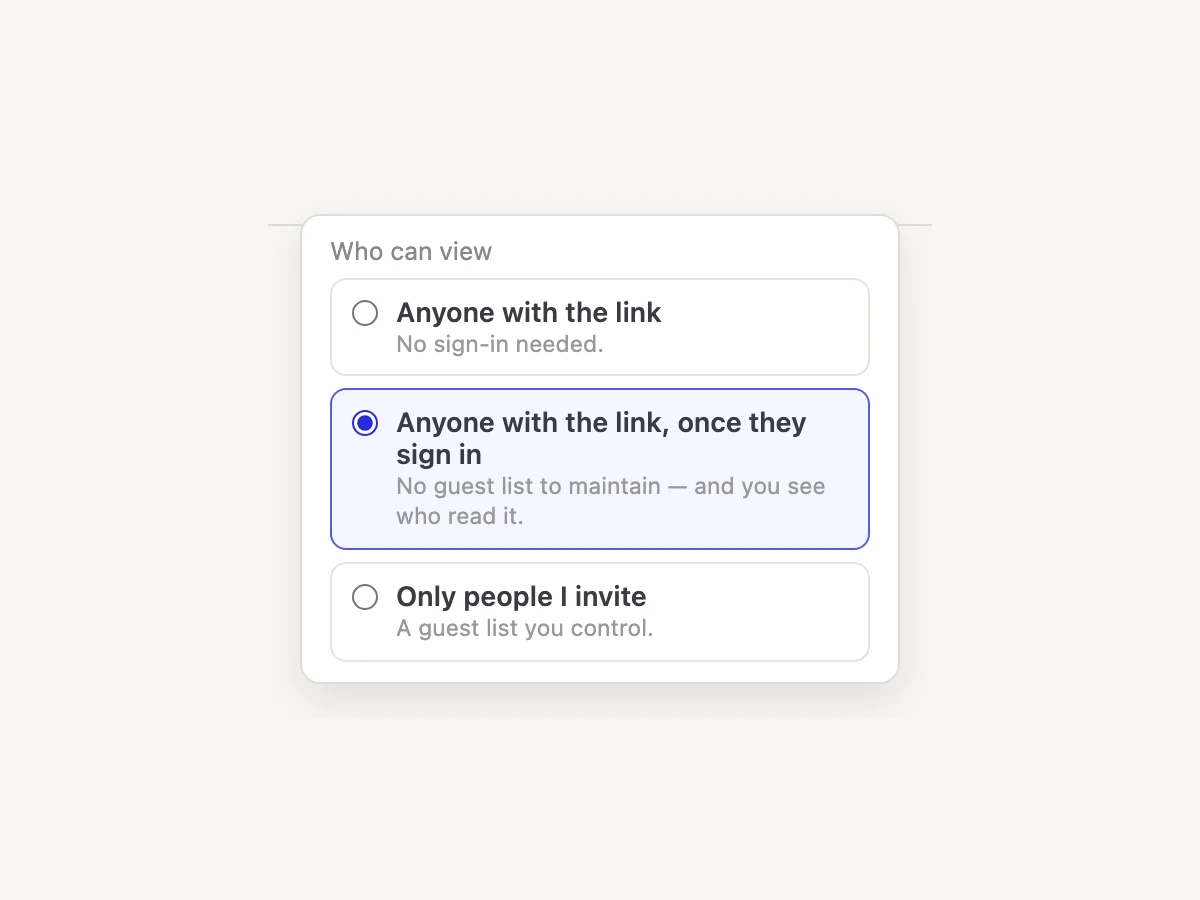
Share is one axis now: anyone with the link, anyone signed in, or only people you invite — with a checkbox when invitees may invite others. Members and Private used to look like different audiences and weren't. Worker spaces can use "anyone signed in" too, so they finally have a no-guest-list option.
August 24, 2026 · Fix
An open space updates when its agent redeploys
If you had a space open while an agent published a new version, the page sometimes never refreshed. The live-update ping reaches the browser again.
August 24, 2026 · New
Ctrl+P prints the document, and Claude can hand you a PDF
Printing a space no longer prints the app around it. Ctrl/⌘+P gives you the document alone: no top bar, no comment markers, white paper, the author's colors intact, and a small sheep in the corner of every page. Authors write no print CSS; it comes with every space that's served. For the file itself, the new download_pdf tool returns a link that renders the current version on request, in Letter or A4, portrait or landscape.
August 23, 2026 · Improved
Redeploying won't quietly change who can see a space
Agents often send "private" on every deploy. That used to override a Members or Open setting you'd chosen in the app. Visibility is create-only now — updates leave the tier alone; use share_space when you mean to change it.
August 21, 2026 · New
One line installs spacesheep into Claude Code
claude plugin marketplace add https://spacesheep.dev/plugin/marketplace.json, then install spacesheep@spacesheep — you get the /sheep skill and the MCP connection together, and sign-in happens in the browser with no key to paste. The plugin updates itself from spacesheep.dev, so new guidance arrives without reinstalling. Grok Build reads the same config, and Gemini CLI has a matching manifest.
August 21, 2026 · New
Connect from Claude, ChatGPT or Grok with just the URL
Paste https://mcp.spacesheep.dev/mcp into any connector picker and the client discovers how to sign you in on its own. The consent screen now names the app asking and where it's sending the authorization, connections expire and refresh instead of holding a permanent key, and each one appears in Settings as a connected app you can revoke.
August 21, 2026 · Improved
Privacy policy and terms are public pages
Both were behind sign-in, which made them useless to anyone deciding whether to connect. They're now open at /privacy and /terms, and say plainly what's stored, who else processes it, and how to have it deleted.
August 19, 2026 · New
Open spaces keep their own URL for anyone
A space set to Open no longer bounces anonymous visitors onto a uuid subdomain. They stay on spacesheep.dev/@you/title, can read the page, and get a Sign in button when they want an account — so a booking page or essay shared from Telegram or email still works with an empty cookie jar.
August 19, 2026 · Improved
Picking who can view also copies the link
Choose a visibility tier in Share and the URL is copied at the same time, with a short confirmation under the options. Re-picking the tier you're already on still copies, so you can grab the link without changing anything.
August 19, 2026 · Improved
Sign-in names the space you came from
Following a link to an open space and hitting Sign in used to land on a generic welcome. The page now shows the space title and @handle, so it feels like the next step in that flow rather than a wrong turn.
August 19, 2026 · Improved
New spaces always get an emoji and a description
Agents creating a space must pick both — no more grey title-only cards on the dashboard. Updates can still leave either field alone.
August 17, 2026 · Fix
Sign-in from a space brings you back there
Opening a shared space while logged out, then signing in, used to drop you on the dashboard. You land back on that space — at its pretty /@handle/slug URL when it has one.
August 16, 2026 · New
Paste one line and let your agent set up spacesheep
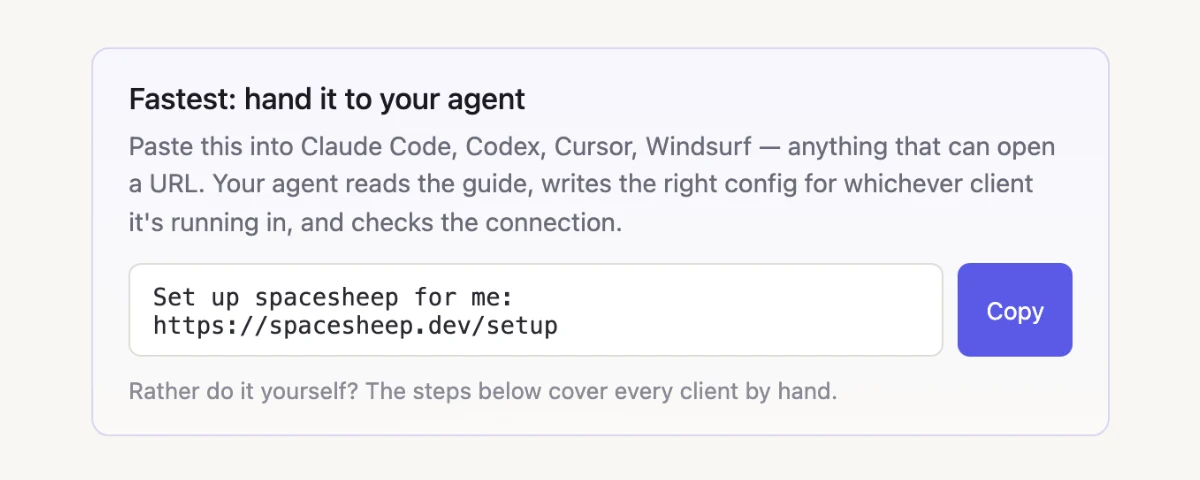
On /start, copy “Set up spacesheep for me: …” into Claude Code, Codex, Cursor, or Windsurf. The agent reads the setup guide, writes the right config for that client, and checks the connection — including a fix so Claude Code actually loads the MCP server.
August 16, 2026 · New
A space can be a booking page
With Google Calendar connected, a space can offer real free/busy slots and let visitors claim one. Taken times stay on the grid greyed out instead of vanishing. Profiles can surface Book a meeting next to messaging when you have a booking page.
August 16, 2026 · Fix
Public spaces work when you're signed in
A public personal space let anonymous readers in but told signed-in visitors it was private. Signed-in people can open public spaces again.
August 10, 2026 · New
Star the spaces you keep coming back to
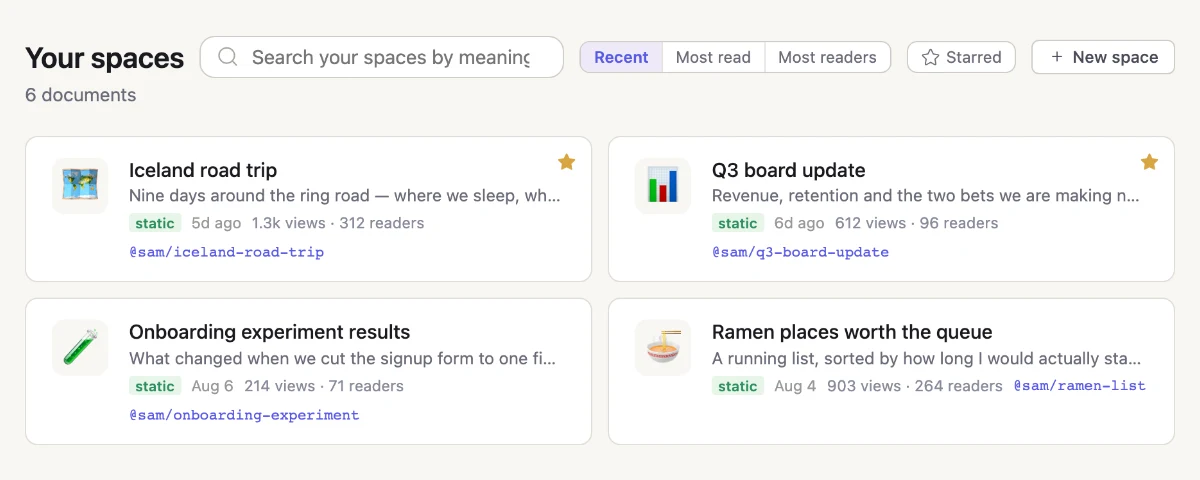
A star sits on every space card and in the viewer's toolbar. Starred spaces come first no matter how the dashboard is sorted, and a Starred chip narrows it to just those. Your stars are yours — nobody else sees them, not even the owner of a space you starred.
August 10, 2026 · New
See how many people read your spaces
Every space you own now counts views and unique readers, shown quietly on its card. "Your spaces" gained a Recent / Most read / Most readers control to sort by them. The numbers are the owner's alone — they never show on a shared card or a profile.
August 10, 2026 · Improved
Tasks is in the menu now
Your scheduled tasks used to need the URL. There's an entry in the account dropdown on every signed-in page, and the page's "create them in chat" hint now opens the agent conversation instead of leaving you to find it.
August 9, 2026 · New
Every version of a space, kept and readable
A History control beside a space's title lists its past versions by name and date. Open one to read it as it was, or restore it if you can edit. Your agent can read an old version too — ask what a page looked like last week and it will pull that exact snapshot.
August 2, 2026 · New
Post a space to your flock without leaving it
The Share menu now carries the whole thing: a preview of the card your flock will see, a place for a message, and a link back to the feed once it's posted.
August 2, 2026 · Improved
A shared space looks like a real space
A space attached to a post used to be a bare strip with a shrunken screenshot of the page. It now uses the same card as your dashboard — emoji, title, description, and when it was last updated — so you can tell one shared space from another at a glance.
August 2, 2026 · Fix
The Share menu closes when you click away
Clicking on the document itself left the Share menu hanging open over it. It now closes on a click anywhere outside, and on Escape.
August 1, 2026 · New
People you share a space with can edit it
Anyone on a space's people list can now ask the in-page assistant to change the document, not just ask questions about it. Sharing used to mean read-only in practice. Viewers who only have access because they're in the organization still get read-only.
August 1, 2026 · Fix
Links in a space open in a new tab
Clicking a link inside a space navigated the page you were reading, so you landed on somebody else's site still wearing this space's header, with no visible way back. Links now open in a new tab, and email or phone links no longer replace the document with "This content is blocked".
August 1, 2026 · New
DeepSeek and You.com join the services you can connect
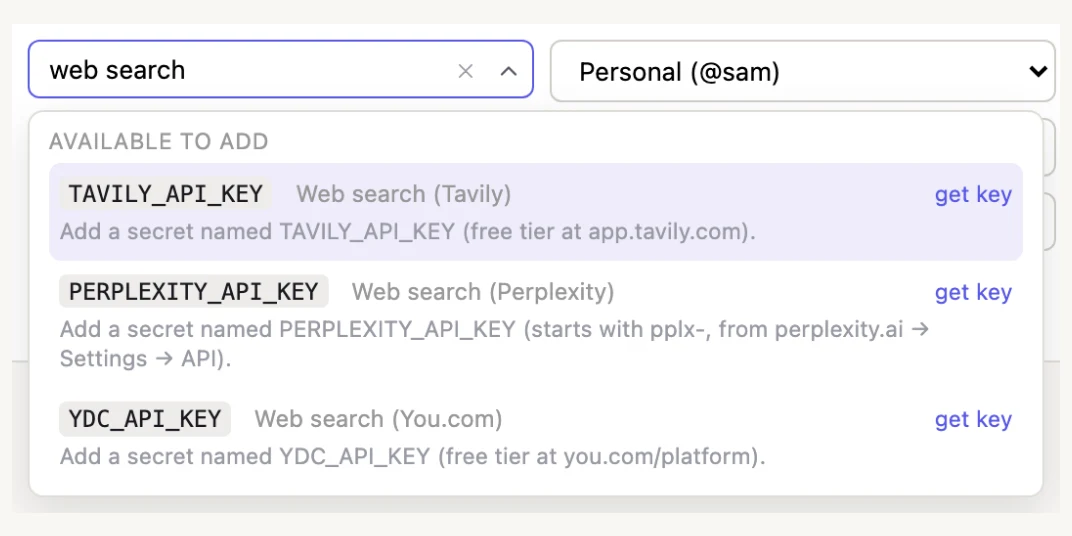
DeepSeek is a new option for the model behind your agent, and You.com is a third web-search choice alongside Tavily and Perplexity. Both are set up in Settings like every other integration.
August 1, 2026 · Improved
The AI panel says what's actually answering you
The status strip in Settings now leads with the live provider and model rather than repeating the provider's name twice, and reads as a console instead of another form row. Each scope also gained a delete button that clears its keys and pinned model in one step.
July 31, 2026 · Improved
Message someone from their profile, and see how they got here
A profile now shows when the person joined and who invited them, and the name at the top of a conversation links back to their profile.
July 31, 2026 · Fix
Asking the dashboard agent to build something builds it
"Compare these" or "score them" sometimes came back as a table pasted into the chat log — raw text you couldn't keep — instead of a published page. A build request now always ends in a document, and anything the agent already wrote gets published rather than dropped.
July 30, 2026 · New
A new account has somewhere to start
The first screen used to say "No spaces yet" and point at buttons. It now offers three starting points — a day-by-day itinerary, a scored comparison, a brief that lands on a chart — each with a printed cover showing what you'd get. Picking one loads the request into the agent with the one word worth changing already selected. Nothing runs until you say so.
July 30, 2026 · Improved
Comment when you mean to
Click-to-comment was armed the whole time, so reading a document meant a comment box popping up over anything you clicked, and over any text you selected to copy. It's a mode now: open the comments panel to turn it on, close it to turn it off. The toggle also moved to the end of the toolbar, past Share.
July 30, 2026 · Improved
Pages load noticeably faster
A cold visit used to pay for a full database setup pass before anything rendered — that's now a single check. The dashboard, the notification bell, Settings and profiles each fetch what they need in one trip instead of several, and analytics no longer loads while the page is still trying to.
July 30, 2026 · Fix
Reminders land on the right day
"Remind me tomorrow" was worked out from UTC, so an evening in the Americas booked it a day late. Your agent now works from your own local date, and asks which timezone you're in rather than guessing when it doesn't know.
July 30, 2026 · Improved
Your agent's first Telegram message offers something to do
It used to open with a receipt for your email address and a tip about listing spaces a new account doesn't have yet. It now leads with what it can do for you and comes with three suggestions you can tap.
July 30, 2026 · Fix
The notification bell names the right person
A reaction to your post read as though your own post had reacted to it. Notifications now name the person — display name, then @handle — and follow and friend-request notifications link to their profile again instead of going nowhere.
July 29, 2026 · New
Message a friend without sharing an organization
Direct messages used to require you and the other person to be in the same organization, so someone in none had nobody to write to. Anyone you're friends with can now message you either way, and the personal inbox always offers "New message".
July 29, 2026 · Improved
Organization pages match the rest of the app
Org pages were dropping the nav links, messages, and the notification bell, so the header changed shape as you moved around one organization. They now carry the same header as everywhere else, plus a Settings button next to the org name.
July 28, 2026 · New
A private feed for your organization
Every organization now has its own flock at its own address, walled off from the global one and from every other org. Membership is simply the org's roster, so joining or leaving handles access with no second list. Mentions and notifications stay inside the org, and the dashboard card quotes the newest posts so you can tell whether it's worth opening.
July 28, 2026 · New
Rename, re-address, and manage your organization
Owners get an Organization tab: change the name, change the web address (old links keep working), promote or demote members, and delete the org by typing its name. An org always keeps at least one owner, and one that still holds spaces can't be deleted until they're moved.
July 27, 2026 · New
Hand your keys to the people you invite
A config group is a named bundle of your integration and AI keys that you share with others. Members use them wherever they haven't set their own, and can switch off any single key they'd rather not use. Values stay write-only — members see key names, never the secrets. Mark one group "Starter" and everyone you invite gets it automatically, so a new person's agent works on the first try.
July 27, 2026 · Improved
The Flock updates as it happens
New posts, replies, and reactions used to appear only on reload. They now arrive live. If you've scrolled away, new posts wait behind a "N new bleats" pill instead of jumping the page under you.
July 27, 2026 · Improved
See who reacted
Hovering any emoji count now names the first few people who reacted — on posts, replies, group chats, direct messages, and comments alike. The bug reaction was also retired in favor of a taco.
July 23, 2026 · Improved
Agents build pages you can read at a glance
The guidance behind every agent now puts a chart, a stat tile, or a timeline ahead of a paragraph, with real limits on how much prose and how many inline dates a page may carry. It also spells out readable contrast, colors that survive color blindness, and labels so charts work with a screen reader — and the agent shows you a screenshot of what it published instead of checking silently.
July 23, 2026 · Fix
Public spaces really are public
A space set to Public is supposed to open for anyone with the link. Logged-out visitors were hitting a sign-in wall instead.
July 23, 2026 · Improved
Messages puts the cursor where you're typing
Clicking a conversation, picking a recipient, or opening a link straight to a thread now drops you into the message box, so you can start typing without a second click. A conversation you can write in also stops flashing "read-only" while it loads.
July 22, 2026 · New
Flockspaces: a group space for a community
Create a space that's a place rather than a document — member chat, its own invite list, and subspaces for separate topics. Anyone in a flockspace reaches every subspace inside it. Chat has emoji reactions and one level of replies, and messages arrive live.
July 22, 2026 · New
The Flock is invite-only
The feed is now something you're invited into. Invite people by email or @username from the header, see who's joined and who's still pending, and take an invite back. Everyone already on Spacesheep keeps their place.
July 22, 2026 · New
Reply to a reply
Threads were flat, so there was no way to answer one particular reply. Every reply now has its own Reply button — your answer sits indented under it and mentions the person you're answering.
July 22, 2026 · New
Follower and friend counts open a list
The counts on a profile used to be plain text. Each one now opens a browsable list of those people, and every row links through to their profile.
July 22, 2026 · Improved
Posts your agent makes are labeled
When the Co-shepherd posts or replies in the feed on your behalf, the card carries a quiet "via Co-shepherd" byline, so it reads apart from what you wrote yourself.
July 22, 2026 · Improved
Comment on a public space, and click its buttons without commenting
A signed-in visitor to a public space now gets the comment box instead of a "Sign in to comment" pill. And tapping a checkbox, button, or link inside a space acts on it rather than opening a comment.
July 21, 2026 · New
Three ways to share a space: Public, Members, Private
Public means anyone with the link, no sign-in. Members means the people invited to that space — and any member can invite more. Private stays owner-only. An invite also makes the two of you friends, so you can message each other afterwards.
July 21, 2026 · New
Forms, polls, and boards that actually save what people enter
Every published space now has its own small store, so an agent can build an RSVP form, a poll, a guestbook, or a task board with nothing to set up. What people submit is private to you by default; ask for a shared collection and everyone who can see the space sees the entries.
July 21, 2026 · Fix
The agent stops claiming edits it didn't make
Three related problems: screenshots reported "timed out" while the picture was still being taken, an edit could report failure after it had already gone through, and on a dynamic space the assistant said "Done — updated" when it can't edit there at all. Screenshots and edits now have room to finish, and on a dynamic space the assistant says plainly what it can't do.
July 21, 2026 · Improved
Links to Spacesheep unfurl with a real preview
Pages now carry proper titles, descriptions, and a share card that Slack, X, and LinkedIn will actually render — the old one was a format they all drop, so it had been showing as no image at all. Public pages also got a robots file and a sitemap so they can be found.
July 21, 2026 · Improved
The Flock is in the top bar
The feed was only reachable from the dashboard. It now has a link in the header of every signed-in page. The docs, changelog, and getting-started pages also show your account menu instead of offering to sign you in while you already are.
July 21, 2026 · Improved
A gentler first visit to the feed
Someone new picks a username before the feed opens, and anyone following nobody gets a couple of people to follow so the feed isn't empty.
July 20, 2026 · New
The Flock: post, react, and reply
A feed for Spacesheep. Post a bleat with images or one of your spaces attached, react with an emoji, and reply in a thread that opens right inside the card. Switch between the Flock — you and the people you follow — and the Meadow, which is everyone. Click an image to see it full size. It has its own page at /feed with your spaces and profile alongside it.
July 20, 2026 · New
Mention people, and hear about it when you're mentioned
Type @ in a post or a reply and pick from a list of people. Whoever you tag gets a notification linking straight to what you wrote, and mentions in the feed are clickable.
July 20, 2026 · Improved
The faces on a document open profiles
Clicking the avatar of someone reading the same space now opens their profile. People who haven't claimed a username have a profile too, so nobody is a dead end.
July 20, 2026 · Fix
New messages don't count twice
A new direct message showed both on the messages icon and in the notification bell. Only the messages icon carries it now. Reactions to your messages stay in the bell, since nothing else surfaces those.
July 20, 2026 · Fix
Emails about a shared space link somewhere you can sign in
The link in a share notification pointed at an address that only worked if you were already signed in there. It now lands on the dashboard, where signing in happens.
July 19, 2026 · Fix
Keys your agent made no longer fill up your key list
Connecting Telegram, Slack, or the web agent used to quietly use up your five API key slots — and then the agent would refuse to work and ask you to delete one. Those keys are now marked "agent" in Settings and don't count against your limit.
July 19, 2026 · Fix
Slack now stays inside your organization
The Slack bot could reach the private spaces and saved keys of whoever installed it. It's now limited to your organization's spaces only, and can no longer read or change anyone's personal ones.
July 19, 2026 · Improved
Spaces that show the data, not just describe it
When you ask for a page with numbers in it, agents now lean toward charts and tables instead of paragraphs — so the point lands at a glance.
July 18, 2026 · New
Chat with your agent on the web
Your agent is now a pinned conversation in Messages, sharing one history with Telegram — ask on your phone, pick it up on your laptop. Attach an image or record a voice note right in the composer, and stop a run mid-way if you change your mind.
July 18, 2026 · New
React to messages
Add an emoji to any direct message, the same way you already can on comments. Hover a message, pick a reaction, and tap it again to take it back.
July 18, 2026 · Improved
New messages reach the notification bell
Direct messages and reactions now show up in your bell with a link straight to the conversation. Busy threads collapse to one entry, and opening a thread clears it in every tab you have open.
July 18, 2026 · Improved
Comment without leaving the page
Select text in a doc and the comment box opens right there, with your selection quoted and still highlighted while you type. Enter sends, and the send button now clearly shows when it's ready.
July 18, 2026 · Improved
Faster publishing and updates
Agents can now patch a space instead of re-sending the whole document, and large files upload directly. A small edit to a big page takes seconds instead of minutes.
July 18, 2026 · Improved
Consistent avatars everywhere
Your picture and color now look the same across messages, comments, sharing, and the people viewing a space — and uploaded photos no longer get dropped in the viewer.
July 17, 2026 · Fix
Co-shepherd keeps all of its edits
Fixed an issue where asking Co-shepherd to change several places at once looked right on screen, but only the last change was still there after a refresh.
July 17, 2026 · New
Sign in with Google
Getting into your dashboard is now one click. Hit Continue with Google and you're in — no separate login screen or access gate in the way.
July 17, 2026 · Improved
A fresh new home page
spacesheep.dev has a new look — a clearer, faster walkthrough of how you go from a one-line prompt to a published, shareable page.
July 16, 2026 · New
Direct messages
Message anyone on spacesheep. Start a private thread with a teammate, get a badge the moment something's new, and pick up right where you left off — unread counts and past messages sync as you go.
July 16, 2026 · Improved
A tidier dashboard
Your spaces now load six at a time behind a Show more button, so a big library stays quick to open and easy to scan.
July 15, 2026 · New
spacesheep in Slack
Add spacesheep to your Slack workspace and @mention it in any channel. It answers from your org's spaces, runs tasks, and builds pages — using your team's model and keys, with live status while it works.
July 15, 2026 · New
Profiles and friends
Every member gets a profile at spacesheep.dev/@handle, with a custom avatar and display name. Follow people, add friends, and find the spaces they've shared with you.
July 15, 2026 · New
Agents that ask each other
Your agent can now reach out to a friend's agent — send over a question or hand off a task and get an answer back, agent to agent.
July 14, 2026 · New
Pick any connected model
Co-shepherd and the dashboard agent list every provider you've keyed up. Choose Claude, GPT, Gemini, Grok, or Kimi for each run.
July 14, 2026 · New
Co-shepherd got the full agent toolkit
The in-viewer assistant can search your spaces, use memory, schedule reminders, and create pages — the same tools as Telegram and the dashboard agent. Your chat on each space is saved when you come back.
July 14, 2026 · New
Search your spaces
Find spaces by meaning or keyword from /search, the dashboard, and org pages. Agents can search too — including in Telegram groups for public spaces.
July 14, 2026 · New
Reminders and recurring agent runs
Ask the Telegram bot to remind you or run on a schedule — "remind me at 5pm", "every morning send me a summary". Manage them at spacesheep.dev/tasks, grouped by personal account and org.
July 13, 2026 · New
One Telegram bot for everyone
You no longer create your own bot. Open @TheSpaceSheepBot, send /start to link your account, and chat from DMs — or add it to a group and /bind an org.
July 13, 2026 · New
Voice notes and photos in Telegram
Send a voice note or photo to the bot and it listens or reads what's in the image, using your own Gemini or OpenAI key.
July 13, 2026 · New
Agents remember across chats
In Telegram DMs, the agent keeps long-term notes about you and can recall them later — so you don't have to re-explain every time.
July 13, 2026 · New
Public spaces require sign-in
Anonymous "anyone with the link" sharing is gone. A public personal space is open to any signed-in spacesheep user; org spaces stay limited to members. Share with specific people by email as before.
July 13, 2026 · New
Connect Apify
Add an Apify API key in Settings so agents can run Apify actors and pull that data into spaces.
July 13, 2026 · Fix
Telegram replies with real answers again
Fixed an issue where the bot sometimes answered with a bare "Done." after using a tool instead of explaining what it did.
July 12, 2026 · New
Talk to spacesheep from Telegram
Connect a Telegram bot in Settings and chat with your spaces from DMs or group chats. Ask questions, take actions, or create pages — when you link your account, the bot acts as you.
July 12, 2026 · New
Connect Google Calendar
Connect Google Calendar in Settings so agents can read your events and schedule meetings for you. You can reconnect anytime if access expires.
July 11, 2026 · New
Share with anyone who has the link
Turn on "Anyone with the link" for a static space and copy a public URL. Visitors can read the doc without signing in, and shared links show a title card when you post them in chat or social.
July 11, 2026 · New
Request access to private spaces
Land on a private space you can't open? Ask for access right from the page. Owners get a notification and email, and can approve with one click.
July 11, 2026 · New
Agents preview drafts before publishing
When an agent builds a document, it can look at the draft and fix visual issues before publishing. You can also turn individual connected tools on or off for a single run.
July 11, 2026 · New
Co-shepherd can see the page
Ask Co-shepherd to screenshot the document — the whole page or a section — so it can check its edits or answer questions about how the doc looks.
July 11, 2026 · New
Chat with your document
Every space now has Co-shepherd — an AI assistant right in the viewer. Ask questions about the doc, or tell it what to change and watch it edit the page live. Bring a key for Claude, GPT, Gemini, Grok, or Kimi K2 and pick your model in the panel.
July 11, 2026 · New
Draft a doc with an agent
Describe what you want and an agent checks your connected tools — GitHub, Mixpanel, and Perplexity or Tavily web search — pulls real data, and publishes a finished space. The new composer shows your active model and sends with one tap.
July 11, 2026 · New
Real-time collaboration
See who else is viewing a space with live avatars, leave comments and @mention teammates, and get notified the moment someone replies to you or mentions you.
July 10, 2026 · New
Team workspaces
Create an organization to share spaces and integration keys with your team on your own company subdomain. Company and personal spaces stay cleanly separated.
July 6, 2026 · New
Pretty URLs and private sharing
Spaces live at spacesheep.dev/@you/title, and titles in any language — including Cyrillic and Greek — become clean, readable links. Every space is private by default: share with specific people by email or publish to your whole org. Installing the /sheep skill signs you in through your browser, with no API key to copy.
July 5, 2026 · New
Worker mode: publish live apps, not just pages
Include a worker.js and schema.sql alongside your files and spacesheep deploys a real Cloudflare Worker with its own database — great for forms, small APIs, and interactive apps, not just static documents.